The Foundation of Every Well-Fitted Garment
Measurements are the most critical data in your tailoring business. A single transposed digit — a 38 written as 83, a shoulder width confused with chest width — can ruin a garment, waste fabric, and damage your relationship with a customer. Yet in most tailor shops, measurements live on paper cards tucked into filing cabinets, scrawled in notebooks, or jotted on the backs of receipts. These records fade, get lost, or become illegible over time. When a returning customer places a new order, you spend precious minutes — sometimes longer — searching for their measurements, only to discover the record is outdated or missing entirely.
TailorXY's measurement storage system replaces this fragile paper-based approach with a secure, searchable, and always-accessible digital measurement database. Every customer's measurements are stored in their profile, organized by date and garment type, retrievable in under a second by name, phone number, or order number. The system maintains a complete measurement history, so you can see how a customer's body has changed over time — invaluable for long-term clients and growing children. You never re-measure a returning customer unnecessarily, and you never use outdated numbers because you grabbed the wrong paper card.
Self-Service Measurement Collection with GIF Guides
One of the most powerful innovations TailorXY brings to tailoring is remote, self-service measurement collection. Here is how it works: when a customer places an order — whether in-person, over the phone, or via your website — you send them a measurement link through SMS, WhatsApp, or email. The customer opens this link on any device and sees a guided measurement form tailored to the specific garment they ordered.
For each measurement field — chest, waist, hip, arm length, shoulder width, inseam — the customer sees a short, looping animated GIF that demonstrates exactly where to place the tape measure, how to hold it, and how to read the number. These visual guides eliminate the ambiguity that makes self-measurement unreliable. A "chest" measurement could mean different things depending on whether the tape sits at the fullest point, at the nipple line, or under the arms. Our GIF guides remove that ambiguity with clear visual instruction.
As the customer enters each measurement, TailorXY validates the input in real time. If someone enters a waist measurement of 200 cm — clearly a data entry error — the system flags it immediately with a gentle prompt: "This measurement seems unusual. Please double-check and re-enter." This validation catches errors before they reach your cutting table, where they would be far more expensive to correct.
Self-service measurement collection is a game-changer for several scenarios. Remote customers who live outside your city can place orders and submit measurements without traveling to your shop. International orders become feasible — a customer in London can order from a tailor in Accra with confidence. Returning customers who want to update their measurements can do so from home rather than scheduling a visit. And busy professionals who do not have time for an in-person session can measure themselves at their convenience.
Organized by Customer, Garment, and Date
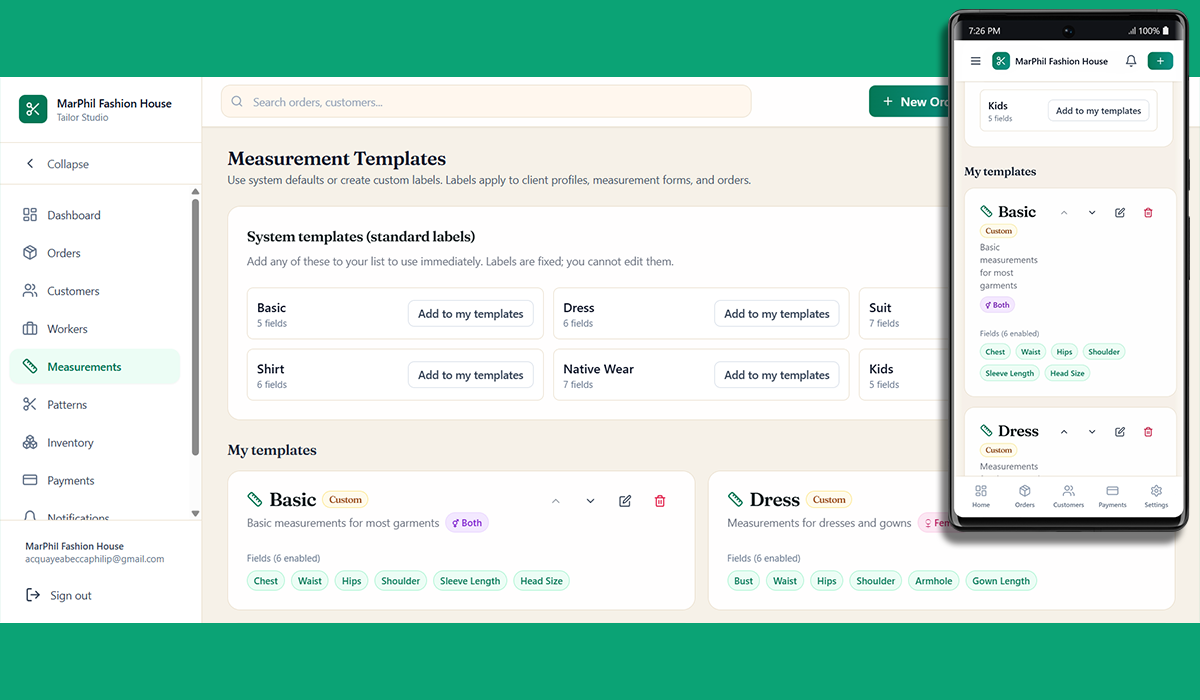
TailorXY organizes measurements along three dimensions. The primary grouping is by customer: every measurement session belongs to a specific customer profile in your customer CRM. Within each customer, measurements are organized by garment type using templates. A shirt template includes chest, shoulder width, arm length, neck, bicep, wrist, and body length. A trouser template includes waist, hip, thigh, knee, ankle, inseam, outseam, and crotch depth. You can create custom templates for traditional garments — agbada, kaftan, dashiki, or any style unique to your market — with whatever fields your craft demands. Finally, every measurement session is date-stamped, creating a chronological history. The most recent measurements are used by default, but older sessions remain accessible.
Reducing Measurement Errors in Production
Measurement accuracy is not just about storing numbers — it is about ensuring those numbers translate into a perfectly fitted garment. TailorXY supports this with several safeguards. First, standardized templates ensure that every staff member captures the same set of measurements for a given garment type. No more forgetting the wrist measurement because it was not on the mental checklist. Second, validation rules flag measurements that deviate significantly from the customer's historical averages, catching both data entry mistakes and genuine changes that warrant a conversation with the customer. Third, measurements flow directly into order records, eliminating the transcription step — a major source of errors — where numbers are copied from one place to another.
Security and Privacy Built In
Customer body measurements are sensitive personal data. TailorXY treats them with the security they deserve. All measurement data is encrypted both at rest and during transmission. Role-based access controls ensure that only authorized staff members can view or modify measurement records. Customers can request their data or ask for it to be deleted in compliance with data protection standards. And because everything is stored in the cloud with automated backups, your measurement database is protected against the risks that paper records face — fire, flood, theft, or simple deterioration. Your customers trust you with intimate details about their bodies. TailorXY helps you honor that trust with enterprise-grade protection.
Integrated With Your Entire Workflow
Measurements do not exist in isolation. They connect to orders, production, and payments. When a worker begins cutting fabric for an order, they pull up the order in TailorXY and see the exact measurements attached — no searching, no guessing, no risk of using the wrong customer's numbers. When you use production tracking, measurement accuracy directly influences your rework rate metric. And when a customer's measurements change, you can proactively recommend a re-fitting or adjustment, turning a potential problem into a service touchpoint that strengthens the relationship.