Why Every Tailor Needs Digital Measurement Software
Body measurements are the foundation of every garment a tailor creates. A millimeter off on the shoulder slope and the jacket hangs wrong; an inch short on the inseam and the trousers look unfinished. Despite this critical importance, the vast majority of tailoring businesses still rely on handwritten measurement slips, sticky notes, or loose sheets tucked into order folders. The result is predictable: lost measurements, illegible handwriting, outdated data pulled for a repeat customer, and costly remakes that eat into already-thin margins.
Tailor measurement software replaces this fragile paper chain with a structured digital system. Every measurement is captured in a standardized template, validated against configurable rules, and stored permanently in the cloud. Whether you operate a single bespoke shop or manage a network of tailoring outlets, digital measurements eliminate the single biggest source of production errors: inaccurate or missing body data.
The Hidden Cost of Paper-Based Measurements
Consider a typical workflow without software. A customer walks into your shop. You measure them using a tape, calling out numbers to an assistant who writes them down. Maybe you transpose a 6 for a 9. Maybe the assistant misses the hip measurement entirely because you were speaking quickly. The slip goes into a folder, where it sits for days or weeks until the fabric is ready to cut. By then, no one remembers the session clearly enough to catch errors.
Industry surveys estimate that 12–18% of bespoke garment remakes trace back to measurement mistakes — not design flaws, not fabric issues, but simple data-entry and data-retrieval errors. For a shop producing 80 garments a month, that translates to roughly 10–14 remakes. Each remake consumes fabric, labor hours, and — worst of all — customer goodwill. Over a year, this silent leakage can total thousands of dollars in wasted materials and lost repeat business.
How Digital Measurement Collection Works
TailorXY approaches measurement collection as a two-track system. The first track is in-store digital entry: when you measure a customer in person, you enter values directly into the app on a tablet or phone. Each field is labeled clearly, and real-time validation flags anything outside expected ranges before you move on to the next measurement. There is no paper step, no transcription, and no delay — the data is stored the moment you tap "Save."
The second track is remote self-service collection, and this is where TailorXY truly sets itself apart. You create a measurement template for the garment type — say, a two-piece suit — and generate a shareable link. The customer opens the link on their phone, watches short GIF animations that demonstrate exactly how to take each measurement (where to place the tape, how to stand, which landmarks to use), enters the values, and submits. The data arrives in your dashboard instantly, already validated and formatted.
GIF-Guided Self-Service: Bridging the Knowledge Gap
Asking a non-tailor to measure their own chest or shoulder width accurately sounds ambitious. Without guidance, most people would hold the tape in the wrong place, pull too tight or too loose, or confuse one measurement with another. TailorXY's GIF-guided instructions solve this by providing a visual, looping demonstration for every single measurement in the template.
Each GIF shows a real person performing the measurement: where to start the tape, how to wrap it around the body, where to read the number. The animations loop continuously so the customer can watch as many times as they need before entering a value. Field-level help text provides additional context ("Measure around the fullest part of the chest, keeping the tape parallel to the floor"), and the validation layer catches any clearly incorrect entries in real time.
The result is remarkably accurate. In testing across thousands of self-service submissions, GIF-guided measurements fall within 1–2 cm of professional in-person measurements for the vast majority of body points. For standard garments like shirts and trousers, this level of accuracy is more than sufficient. For high-precision work like fitted blazers or corsets, tailors can request a secondary verification measurement for specific fields.
Measurement Templates: Standardize What You Collect
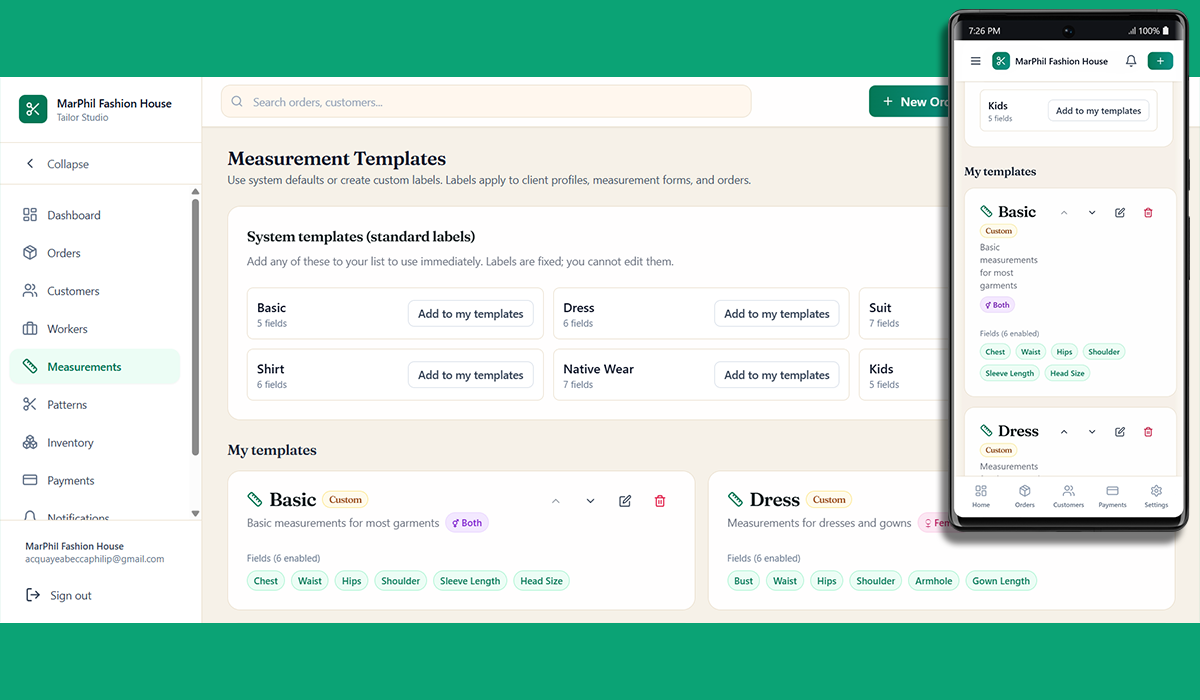
Different garments require different measurements, and different tailors have different naming conventions. TailorXY's template system brings order to this variation. You define a template once — listing every measurement field, its label, acceptable range, unit, and display order — and then reuse it across all orders of that garment type.
Pre-built templates for shirts, trousers, blazers, dresses, skirts, and traditional garments ship with TailorXY out of the box. You can use them as-is or customize them freely. Need a specific "back neck drop" measurement for your saree blouse template? Add it. Want to remove "thigh circumference" from your trouser template because you draft from the hip? Remove it. The flexibility ensures TailorXY fits your workflow rather than forcing you to adapt.
History Tracking and Customer Profiles
Bodies change. Weight fluctuations, aging, pregnancy, and athletic training all alter body measurements over time. TailorXY maintains a complete version history for every customer, timestamped and immutable. When a returning customer places a new order, you can pull up their latest measurements with one click — or compare their current session against previous ones to spot significant changes.
This history is invaluable for long-term customer relationships. A customer who orders a new shirt every quarter does not need to be re-measured each time. And when their measurements do shift, you see the trend immediately rather than discovering a fit problem after the garment is sewn. Linking measurement data to your production management workflow ensures the correct, most recent data always travels with the order through cutting, sewing, and finishing.
Serving International and Remote Customers
The rise of e-commerce has expanded the addressable market for bespoke and made-to-measure tailoring far beyond the local neighborhood. Customers in Dubai order from tailors in Lagos; groomsmen scattered across three continents need matching suits from a single atelier in London. The bottleneck in all these scenarios is the same: how do you get accurate measurements from someone you cannot physically meet?
TailorXY's remote collection links solve this problem cleanly. You generate a link, share it through any communication channel, and the customer handles the rest. Automatic unit conversion means an American customer entering inches and a European customer entering centimeters both deliver data in your shop's preferred system. Combined with order tracking and payment collection, you can run a fully remote tailoring operation without ever meeting your customer in person.