Why Garment Production Tracking Is the Missing Piece in Most Workshops
Walk into any busy tailoring workshop and ask the owner a simple question: "How many garments are currently in the sewing stage?" In most shops, the answer requires a physical walk through the workspace, a conversation with each worker, and several minutes of mental tallying. Now ask a follow-up: "Which of those are behind schedule?" The silence is usually telling.
This lack of production visibility is not a minor inconvenience — it is the root cause of missed deadlines, idle workers, customer complaints, and revenue leakage. When you cannot see the state of your production floor in real time, you are managing by gut instinct rather than data. And gut instinct does not scale. Garment production management software exists to close this visibility gap, giving workshop owners and production managers a live, accurate picture of every garment's journey from order confirmation to customer delivery.
The Anatomy of Production Bottlenecks
Production bottlenecks in tailoring workshops follow a predictable pattern. The cutting stage is often fast because it depends on a single skilled worker with direct access to fabric. But once cut pieces fan out to multiple sewers, the workflow fragments. Some sewers finish quickly; others fall behind due to complexity differences, machine breakdowns, or simple distraction. Without a tracking system, the fast sewers sit idle waiting for new work while the slow ones accumulate a growing backlog.
The finishing stage introduces another chokepoint. Buttonholes, hand-stitched details, pressing, and final inspection often bottleneck around one or two specialized workers. A single absence — illness, family emergency, or even a long lunch — can stall a dozen orders. Meanwhile, the customer-facing staff has no idea why orders promised for Thursday are not ready, and they make commitments for Friday that the production floor cannot honor either.
These cascading delays compound week over week. A workshop producing 100 garments per month might experience 15–25 deadline overruns simply because no one had a clear, centralized view of what was happening. The transition from paper-based tracking to digital order management solves the order-level problem, but production tracking goes deeper — it solves the task-level problem within each order.
How Production Tracking Software Solves These Problems
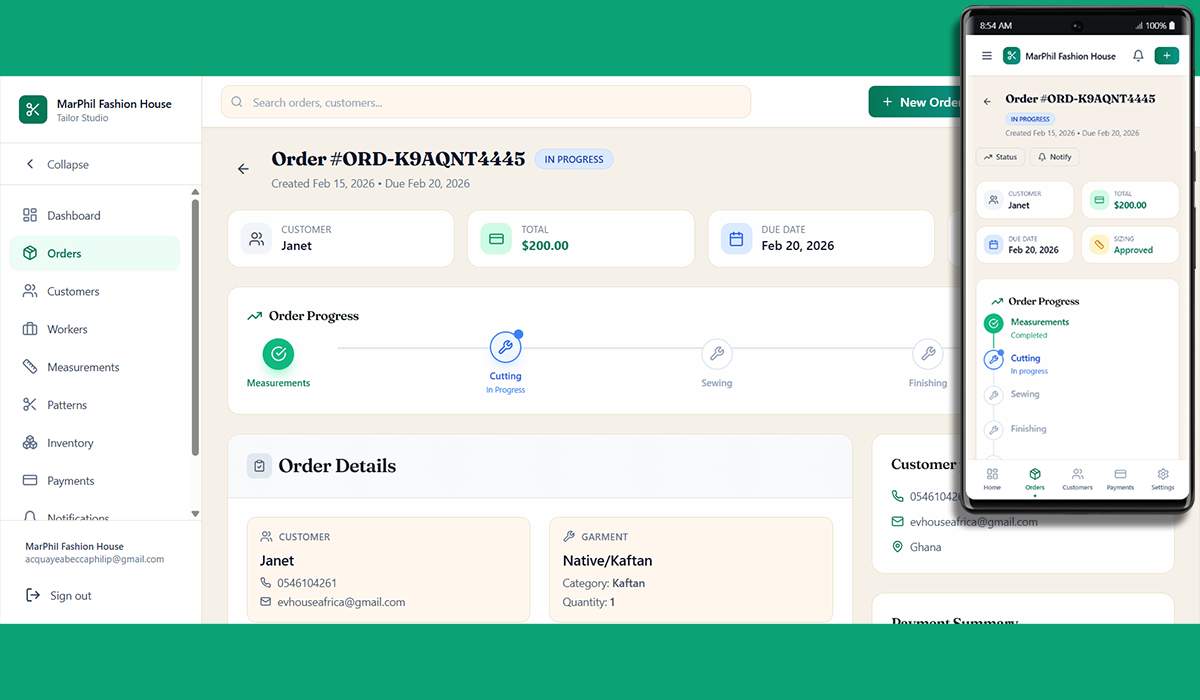
TailorXY's production management module introduces three core capabilities that traditional pen-and-paper or spreadsheet tracking cannot match: real-time status visibility, worker-level task assignment, and proactive deadline management.
Real-time status visibility means every garment in your workshop has a digital card that lives on a visual pipeline board. The board is divided into columns representing your production stages. When a cutter finishes cutting a garment, they tap their phone to move the card to the "Ready for Sewing" column. The sewer assigned to that garment sees it appear in their task list, picks it up, and moves it to "In Sewing" when they start. At any moment, you can open the dashboard and see exactly how many garments are in each stage, which ones are on schedule, and which ones are falling behind.
Worker-level task assignment ensures accountability. Instead of announcing "here are today's orders" to the room and hoping everyone grabs the right work, you assign specific garments to specific workers. Each worker sees only their tasks, along with the garment's measurements (pulled directly from TailorXY's measurement system), style notes, fabric details, and deadline. There is no ambiguity about who is responsible for what.
Proactive deadline management shifts you from reactive firefighting to preventive action. TailorXY calculates expected completion dates for each stage based on historical averages and sends alerts when a garment is approaching its deadline without progressing. You learn about potential delays before they become missed deadlines, giving you time to reassign work, add overtime, or communicate proactively with the customer.
Quality Checkpoints: Catch Defects Before They Compound
One of the most expensive moments in garment production is discovering a defect at the finishing stage that originated during cutting. The further a defect travels down the pipeline undetected, the more labor and material are wasted. TailorXY addresses this with configurable quality checkpoints between any two production stages.
A quality checkpoint is a set of verification items that a worker must confirm before a garment can advance to the next stage. For example, between cutting and sewing, the checkpoint might require: "Pattern pieces match measurement card," "Grain line aligned correctly," and "Notches and markings transferred." The worker physically inspects the garment, checks each item in TailorXY, and only then can the garment move to sewing.
This systematic approach to quality control transforms defect detection from an end-of-line afterthought into an integrated part of the production process. Shops that implement checkpoint workflows typically see a 40–60% reduction in rework within the first three months of use.
Worker Performance and Capacity Planning
Data collected through production tracking enables a new level of workshop management insight. TailorXY aggregates task completion times, on-time rates, and quality scores per worker, giving you an objective basis for workload distribution, training decisions, and performance conversations.
Capacity planning uses this same data to project your workshop's throughput. When a customer asks whether you can deliver 30 suits in three weeks, you no longer guess — you check the capacity view, see your current pipeline load, compare it against historical throughput, and give a confident answer. This data-driven approach to scheduling protects both your reputation and your team's well-being by preventing over-commitment, and it integrates naturally with alteration and repair tracking if your shop handles both bespoke production and alterations.
From Order to Delivery: The Complete Production Loop
TailorXY ties production tracking to every other part of the tailoring workflow. An order enters the system with customer details, measurements, style specifications, fabric allocation, and a promised delivery date. The production module picks up from there, breaking the order into stage-by-stage tasks, assigning workers, enforcing quality checkpoints, and tracking progress until the garment is marked "Ready for Delivery." At that point, the order management system notifies the customer and updates payment status. The loop is closed, and the data feeds back into analytics for continuous improvement.