From Guesswork to Data-Driven Production Management
In a busy tailoring workshop, dozens of garments are in various stages of production at any given moment. Some are being cut, others are mid-sewing, a few are waiting for fittings, and several are in their final finishing stage. Without a production tracking system, the shop owner carries this information in their head — a precarious arrangement that breaks down as order volume grows. You cannot promise accurate delivery dates because you do not truly know your current workload. You discover delays only when a customer calls to complain. You cannot identify which stage or which worker is causing the bottleneck because the data simply does not exist.
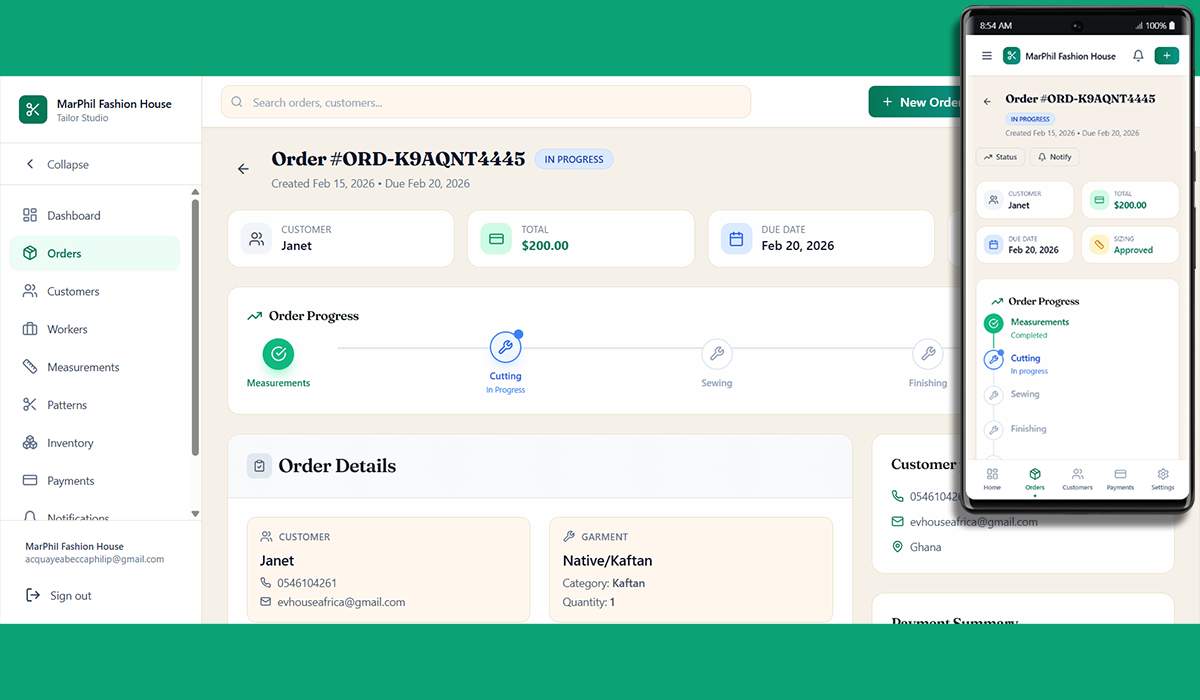
TailorXY's production tracking transforms this guesswork into a visual, data-driven management system. Every order in your production pipeline is represented on a Kanban-style board, organized by the stage it is currently in. You see at a glance how many garments are in cutting, how many are in sewing, how many are awaiting fittings, and how many are ready for delivery. Orders that are on schedule appear in green. Orders approaching their deadline appear in amber. Orders that have exceeded their time standard appear in red. This traffic-light visualization gives you immediate situational awareness — no mental arithmetic required.
Assigning Work Intelligently
In a one-person operation, task assignment is simple — you do everything yourself. But the moment your team grows beyond two or three people, coordinating who works on what becomes a major management challenge. Without a system, assignments happen verbally: "Ama, start sewing the blue dress." "Kwame, cut the fabric for order 47." These instructions are forgotten, misheard, or superseded by conflicting priorities. Workers are uncertain what to prioritize. Some are overloaded while others wait for direction.
TailorXY eliminates this friction by providing digital task assignment that connects to your production pipeline. When an order enters a new stage, you assign it to a specific worker. That worker sees the task in their queue — on their phone, tablet, or any device — along with the order details, customer measurements, design specifications, and deadline. They know exactly what to do, for which order, and by when. When they complete the task, they update the status with a single tap, which automatically moves the order to the next stage and can trigger the next worker's assignment.
The system also shows you each worker's current workload. If Ama has twelve items in her sewing queue and Yaa has three, you know to route the next sewing task to Yaa. This load-balancing capability is invisible to your team — they simply receive their assignments — but it prevents the overwork-underwork imbalance that causes missed deadlines and worker burnout.
Time Standards and Capacity Planning
How long should it take to cut a formal shirt? To sew a pair of trousers? To finish a wedding gown? Every experienced tailor has a rough intuition, but intuition is not precise enough for reliable delivery promises. TailorXY lets you define time standards for each production stage by garment type. A casual shirt cutting stage might have a one-hour standard, while a three-piece suit cutting stage might be four hours. These standards serve two critical purposes.
First, they enable accurate delivery date calculation. When a new order enters the system, TailorXY adds up the time standards for each remaining stage, factors in the current queue of orders ahead of it, and calculates a realistic completion date. You can share this date with the customer with confidence, knowing it is based on data rather than optimism.
Second, time standards enable early delay detection. If an order's cutting stage has a two-hour standard but it has been in cutting for six hours, the system flags it. You can investigate immediately — is the worker struggling with complex fabric? Is there a machine issue? Is the order blocked waiting for materials? — and take corrective action before the delay cascades through the rest of the pipeline. This proactive approach is fundamentally different from the reactive one that most shops practice, where delays are discovered only at the delivery deadline.
Identifying and Eliminating Bottlenecks
Every production system has bottlenecks — stages where work piles up because the capacity is lower than the demand. In tailoring, common bottlenecks include the sewing stage (the most labor-intensive), the fitting stage (dependent on customer availability), and the cutting stage (often handled by a single specialist). Without tracking data, you may sense that "things are slow" but cannot pinpoint why.
TailorXY's analytics dashboard reveals bottlenecks with precision. If your cutting stage consistently has more orders waiting than any other stage, the data tells you clearly: you need more cutting capacity. You can hire another cutter, cross-train a sewing specialist, or invest in faster cutting equipment. If fitting appointments are the bottleneck, you can implement proactive scheduling at order creation time and send automated reminders to reduce no-shows. Every decision is backed by production data, not gut feeling.
Worker Performance and Growth
Production tracking naturally generates performance data for each worker: tasks completed per week, average task duration, on-time completion rate, and rework rate. TailorXY presents this data constructively — it is a tool for fair workload distribution, accurate payroll (especially for piece-rate compensation), and targeted training, not surveillance. Workers who consistently exceed time standards can be recognized and rewarded. Workers who struggle with a particular garment type can receive additional training. The system creates accountability without micromanagement.
When combined with payment tracking, production data also lets you calculate your true cost per garment: how much labor time goes into each piece, mapped to your labor costs. This insight is essential for pricing accuracy and profitability analysis — ensuring you are not undercharging for complex garments that consume disproportionate production time.