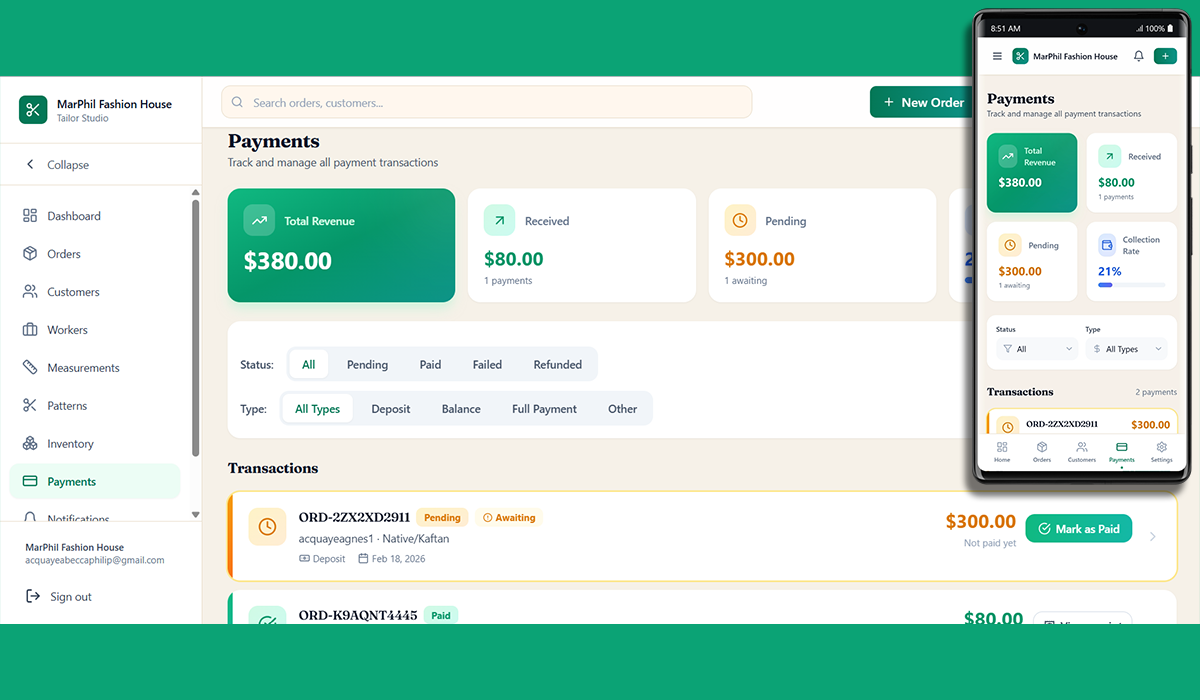
The Financial Backbone of Your Tailoring Business
Getting paid should be the simplest part of running a tailoring business, yet it is often the most fraught. Customers forget what they owe. Deposits are recorded on scraps of paper that disappear. Balances are disputed because there is no clear record of what was paid and when. The awkward "I already paid that" conversation erodes the trust you have built through beautiful craftsmanship. And at the end of the month, you spend hours trying to reconcile your actual revenue against what you think you earned, only to discover gaps you cannot explain.
TailorXY's payment and invoicing system eliminates this financial friction by creating a clear, auditable payment record for every order. From the moment a customer places a deposit to the final balance payment at delivery, every transaction is recorded with the amount, date, payment method, and an optional receipt. You always know exactly how much a customer owes, how much you have collected this week, and how much outstanding revenue is sitting in your pipeline. No guesswork, no arguments, no lost receipts.
Handling the Unique Payment Flow of Tailoring
Tailoring has a payment structure unlike most businesses. A restaurant collects full payment at the end of a meal. An e-commerce store charges the card at checkout. But a tailor collects money in stages: a deposit when the order is placed, sometimes a second payment at the fitting, and a final balance when the garment is delivered. This multi-stage payment flow creates complexity that generic invoicing tools simply do not handle well.
TailorXY was designed around this exact workflow. When you create an order, you set the total price and record the initial deposit. The system calculates the remaining balance automatically. As additional payments come in — at fitting, at a scheduled installment date, or at delivery — you record each one with a tap. The order record always shows a running total: total price, total paid, and balance remaining. This three-number summary is visible to you, your team, and optionally to the customer through their order tracking link.
You can accept and record payments in any method your customers prefer — cash, card, bank transfer, Mobile Money (MTN MoMo, Vodafone Cash, Orange Money), online payment links, or any combination. TailorXY does not process the payment itself; it tracks the payment regardless of how it was made. This flexibility means you do not need to change your existing payment infrastructure. You simply add a recording layer that turns scattered transactions into organized financial data.
Professional Invoices That Build Credibility
A handwritten receipt might suffice for a loyal local customer, but it undermines your professionalism with new clients, corporate customers, and international orders. TailorXY generates branded, itemized invoices directly from your order data. Each invoice includes your business name and logo, a sequential invoice number, the customer's details, a line-by-line breakdown of each garment and service, unit prices, totals, applicable taxes, and your payment terms.
Invoices can be sent to the customer via email, shared as a link, downloaded as a PDF, or printed. They serve as both a payment request and a professional record of the transaction. For customers who need invoices for their own accounting — particularly corporate clients ordering staff uniforms or event organizers commissioning costumes — this capability is not a nice-to-have but a requirement. Shops that provide clean, professional invoices are perceived as more trustworthy and are more likely to win high-value contracts.
Automated Reminders That Eliminate Awkward Conversations
Chasing payments is one of the most unpleasant aspects of running a tailoring business. You do not want to damage a customer relationship by nagging them, but you also cannot afford to let balances go uncollected. TailorXY solves this with automated payment reminders that feel professional rather than confrontational.
You configure the reminder schedule once — for example, a friendly SMS three days before the delivery date, a follow-up on the day the balance is due, and escalating reminders at three-day and seven-day intervals after the due date. The messages are sent automatically using templates you customize. The tone stays consistent and professional, and the customer receives a clear statement of what they owe with a link to their order details. Most customers pay promptly after the first or second reminder, eliminating the need for you to make uncomfortable phone calls.
Financial Visibility and Business Intelligence
When every payment flows through TailorXY, you gain financial visibility that is impossible with manual record-keeping. The dashboard shows your total revenue for any time period, outstanding receivables (how much customers collectively owe you), revenue by payment method (useful for understanding how your customers prefer to pay), and revenue by garment type (revealing which products are most profitable).
You can see your top customers ranked by total spend — valuable for loyalty programs and VIP treatment. You can identify customers with overdue balances and take action. You can compare revenue month-over-month to track growth. And at tax time, you can export your financial data in a format compatible with accounting software like QuickBooks or Wave, turning days of manual reconciliation into a one-click export.
When paired with production tracking data, payment records also enable profitability analysis by garment type. If a particular style takes ten hours of labor but is priced the same as a garment that takes four hours, your margins are quietly eroding. TailorXY surfaces these insights so you can adjust pricing, decline unprofitable work, or find ways to produce more efficiently.
Connected to Your Customer and Order Data
Payment tracking in TailorXY is not a standalone feature — it is deeply integrated with your customer CRM and order management system. Every payment is linked to a specific order and a specific customer. When you open a customer's profile, you see their complete payment history: total lifetime spend, payment reliability (do they pay on time?), and any outstanding balances across all their orders. When you open an order, you see its payment status alongside the production status, delivery date, and customer details. This integration means that payment decisions — whether to require a larger deposit from a customer who has a history of late payment, or to extend credit to a loyal VIP — are always informed by data.